Chapter I: The Iron Grate of Pierce County
The actions that you take, the decisions you make are they to impress people or to impress Almighty God? Do you trust God? Or do you believe that God should bend to your will?
(Puyallup, Washington) The rain in Pierce County does not merely fall; it weeps. It streaks slowly down the grey concrete walls of the jailhouse. If there were windows the endless rain water would blurr every view of the outside world into a smear of leaden skies and distant, unreachable green hills. Inside, the air was thick with the smell of institutional bleach and old rank despair.
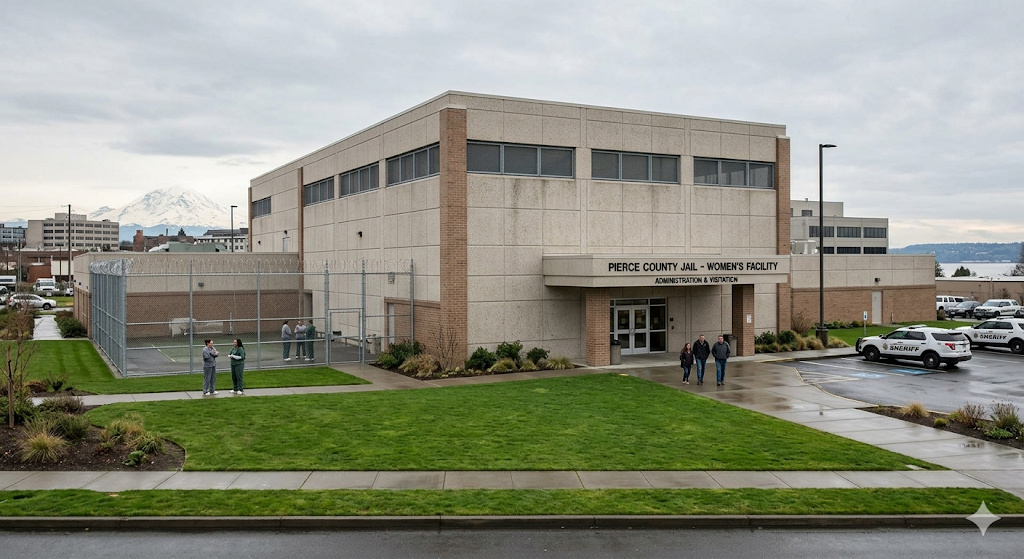
In a narrow cell sat Clara.
To the law, Clara was a criminal—a woman caught in the desperate, tangled web of illicit trades, driven by the harsh winter and an empty cupboard to commit deeds that society could not forgive. She had broken the statutes of man, and for that, the heavy iron doors had clanged shut behind her, severing her from the outside world as she held dear.
Yet, beneath the coarse denim of her inmate uniform beat the fiercely tender heart of a mother and a devoted, loyal wife. Every hour of her confinement she offered up a silent prayer for her sanctuary: a large, weathered homestead nestled near the banks of the Puyallup River that her husband worked tirelessly for to provide for her and their children. There lived her devoted husband, Samuel, their nine bright-eyed children, and the large extended family who anchored their bustling world.

“The Lord will keep them,” Clara whispered into the cold bricks of her cell, her fingers tracing a worn photograph. “Man may lock me away, but His mercy shelters the innocent.”
How little does blind mortality see of the gathering storm! While Clara bowed her head in repentance, the shadow of a cruel fate was already lengthening over her valley.
Chapter II: The Shadow on the Valley
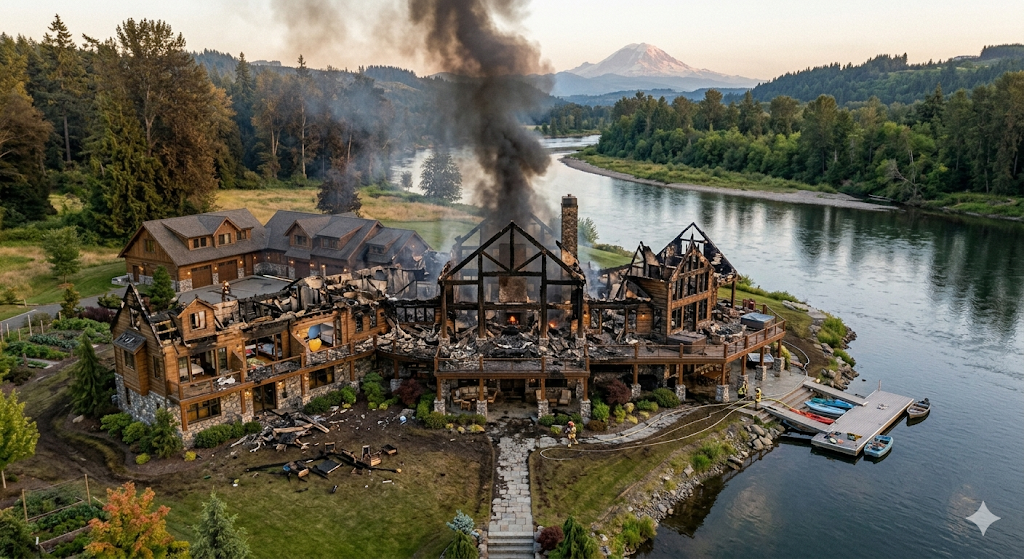
It was a night of howling winds when the terror came. A sudden, catastrophic fire—born of malice from lawless men with whom Clara had once crossed paths—stealthily they crept upon the sleeping homestead.
The flames did not discriminate. They leapt hungrily from the dry timbers of the porch to the cedar shingles, fueled by a ferocious gale wind blowing inland from the coast of the Pacific Ocean.
Samuel, awakened by the choking smoke and his barking dogs, fought like a lion to save his flock. With skin burning and lungs tearing, he dragged his elderly parents toward the threshold, only for the heavy roof beams to collapse in a shower of brilliant, fatal sparks. All the children cried out over and over for their dear mother—cries that were swallowed by the roaring furnace voluminous wind and towering flames.
By the time the grey dawn broke over Pierce County, the homestead was nothing but a blackened scar upon the earth. Three generations of life, love, and quiet endurance had been snuffed out in a single, merciless hour.
Chapter III: The Agony of a Mother
The news was brought to the jail by a somber Chaplain Jefferson Morris, whose eyes carried the weight of the devastating decree. He found Clara sitting on her bunk intently staring at the Black Jack gambling game on her cell phone.
“Clara,” the chaplain said, his voice trembling like a reed in the wind. “Put down your phone. I bring heavy tidings from the river.”
When the truth was spoken, it did not evoke a scream or a loud lament. The blow was too colossal for mere human noise. Clara grew white as the shroud they would weave for her children. She rose to her feet, her hands outstretched as if to ward off a physical blow, and then fell to the concrete floor like a stone. She had been deceived. There was no spells to help her. There was no friendships to be had. There was forgiveness and redemption but consequences… they don’t disappear on the word “Sorry”.
For days, Clara hovered on the precipice of madness and death. The jailers, hardened by years of witnessing human misery, averted their eyes when they passed her cell. The grief that echoed from that corner was not the rage of a convict; it was the sacred, shattering lamentation of Rachel weeping for her children, refusing to be comforted, because they were not.
Chapter IV: The Heavenly Vision
A week passed, and the fever of the brain subsided into a deep, supernatural stillness. Clara lay upon her narrow cot, her eyes fixed upon the small high window where a single ray of golden sunlight managed to puncture the Pierce County gloom.
She had passed through the valley of the shadow, and though her heart was broken, a strange, celestial light now shone through the cracks. For days, weeks, months her cell was crowded with them all – silent specters of her family, her husband and all the others her choices had harmed…including the child she most harmed – little Clara of the Puyallup River.
“You are all here…” she whispered to the empty cell, a tear stealing down her cheek, though her lips smiled. “My handsome husband Samuel, my sweet babies, all of my family… the fire took their earthly garments, but it could not touch their souls. Will you take me with you?”
In her mind’s eye, the dark walls of the prison seemed to dissolve. She no longer saw the blackened ruins beside the Puyallup River. Instead, she saw a land where there is no more night, neither sorrow nor crying. She saw her children walking hand-in-hand through fields of celestial green, led by a Shepherd whose face was brighter than the sun.
“I am bound here in chains for my misdeeds,” Clara said, raising her hands toward the light. “But they are free. The world was cruel to us, but they have reached the shore where the wicked cease from troubling, and the weary are at rest. Break my heart, O Lord, if Thou must, so that Thou mayest fill it with Thyself. I shall tarry here in my prison until Thou callest me home to meet them.”
And so, the criminal mother remained in her cell—chastened, sorrowful, yet strangely triumphant—waiting for the day when the gates of a higher Kingdom would open, and no iron bar could ever separate her from her loved ones again. Selah

Morale: What you do and what you do not do is coming back to you. – Coletha Albert
…But God doesn’t use the word “habits.” He uses the metaphor of seeds. Why? In biblical times, people lived in an agrarian society. Nothing was manufactured or cranked out in fast-food joints. Food had to be grown one ingredient at a time. People’s lives and economy were based largely on farming. People back then would understand the concept of planting seeds and harvesting crops, so here’s what God inspired Paul to write: “Do not be deceived: God cannot be mocked. A man reaps what he sows. Whoever sows to please their flesh, from the flesh will reap destruction; whoever sows to please the Spirit, from the Spirit will reap eternal life. Let us not become weary in doing good, for at the proper time we will reap a harvest if we do not give up” (Galatians 6:7–9). https://www.thenivbible.com/blog/you-reap-what-you-sow/
 Ms Coletha's Blog